Sunday, February 26, 2023

The last of C/2022 E3 (ZTF)


This was my last attempt at Comet C/2022 E3 (ZTF) before it leaves us for 50,000 years, if it returns at all.  Latest estimates of its orbit have astronomers thinking it may not return at all.  Good while it lasted!

Photo Details
February 12, 2023
Orion 8" Astrograph on Celestron AVX Mount
SBIG STF-8300C Camera
Skyglow filter
55 subframes at 1 minutes/frame
Total Exposure Time = 55 minutes
Image Acquisition in CCDOps
Image Stacking in Deep Sky Tracker
Image Processing in PhotoShop


Saturday, February 11, 2023

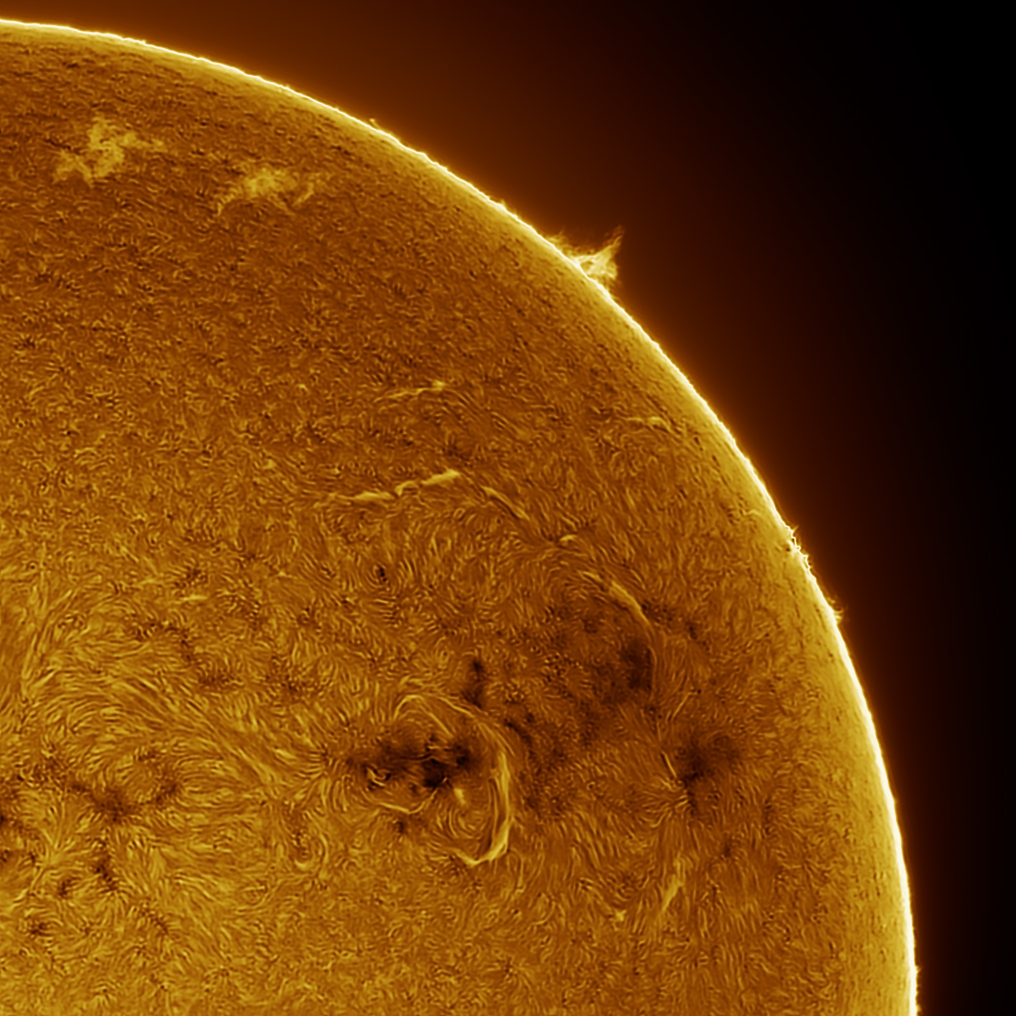
Sol on Feb 4, 2023


Lots of prominence activity as Sol is rapidly approaching solar maximum.  I had difficulty getting the double stack perfectly on band so there was a lot of ghosting when shooting the full disk so it's not included here.  Definitely need to continue working on that skill. 

Photo Details

February 4, 2023
Lunt Ha 60mm double-stacked solar telescope
ZWO ASI178MM 
SharpCap - 8 Bit Mono
Image Stacking in AutoStakkert
Adjustments in ImPPG
Final Adjustments in Photoshop

Wednesday, February 8, 2023

C/2022 E3 (ZTF) & Capella


Comet C/2022 E3 (ZTF) passed near the star Capella on the night of  February 5, 2023.  I tried a couple different postprocessing techniques.  The top photo used Deep Sky Stacker's "Track on Comet and Stars" routine while the bottom photo is tracking on the comet only.  Pushing the saturation in the bottom photo brought out a hint of the green hue that's been discussed in mainstream media.  The green comes from diatomic carbon in the comet being excited by solar ultraviolet radiation.  I'm still waiting for a clear moonless night to get better views, but it's already put on a great show.

Photo Details
February 5, 2023
Astrotech 65Q Refractor on Celestron AVX Mount
SBIG STF-8300C Camera
Skyglow filter
113 subframes at 1 minutes/frame
Total Exposure Time = 1 hour 53 minutes
Image Acquisition in CCDOps
Image Stacking in Deep Sky Tracker
Image Processing in PhotoShop

Saturday, February 4, 2023

First Solar of 2023


These are my first solar images of 2023 and it's picking up where 2022 left off.  I was able to use a 3x Barlow on some of these that really helped dig out the details.  More to come! 

Photo Details

January 7, 2023
Lunt Ha 60mm double-stacked solar telescope
ZWO ASI178MM 
SharpCap - 8 Bit Mono
Image Stacking in AutoStakkert
Adjustments in ImPPG
Final Adjustments in Photoshop

Comet C/2022 E3 (ZTF)


Comet C/2022 E3 (ZTF) has been making the rounds in mainstream media.  It's estimated that the nucleus is about 1 km across and has a tail that extends for millions of kilometers.  I wasn't able to see it naked eye last night and through the eyepiece of my telescope it was a fuzzball due to the bright moonlight washing everything out.  I hope to have another chance at it on a moonless night next week.

Photo Details
February 3, 2023
Orion 8" Astrograph on VX Mount
SBIG STF-8300C Camera
Baader MPC Mark III Multi-Purpose Coma Corrector
Skyglow filter
26 subframes at 1 minutes/frame
Total Exposure Time = 26 minutes
Image Acquisition in CCDOps
Image Stacking in Deep Sky Tracker - Using Comet Settings
Image Processing in PhotoShop

Sunday, January 15, 2023

Last Solar of 2022


Solar maximum isn't expected until 2025 but 2022 was a very active year.  These are the last shots I got before the start of the new year and hoping to keep seeing increasing activity through 2023.

Photo Details

December 28, 2022
Lunt Ha 60mm double-stacked solar telescope
ZWO ASI178MM 
SharpCap - 8 Bit Mono
Image Stacking in AutoStakkert
Adjustments in ImPPG and Registax
Final Adjustments in Photoshop

Tuesday, December 27, 2022

December Sun


The Sun is ending 2022 as actively as it started.  Hoping for more in 2023!

Photo Details

December 18, 2022
Lunt Ha 60mm double-stacked solar telescope
ZWO ASI178MM 
SharpCap - 8 Bit Mono
Image Stacking in AutoStakkert
Adjustments in ImPPG and Registax
Final Adjustments in Photoshop


Tuesday, December 20, 2022

Soul Nebula (Westerhout 5 / IC 1848)


The Soul Nebula (Westerhout 5 / IC 1848) is a massive emission nebula located in Cassiopeia.  If it were bright enough to see with the naked eye, it would cover about 5 times the width of a full moon.  Emission nebulae are clouds of gas that have been ionized such that that emit their own light.  The stars in this region are relatively young (just a few million years old) while our own Sun is about 5 billion years old.

Looking at the Soul Nebula, for me, it doesn't immediately conjure up thoughts related to souls, so where does the name come from?  A wider view would reveal a nearby neighbor called the Heart Nebula resembles a Valentine heart, so together they are the Heart and Soul Nebulae.  Who says astronomers and scientists aren't poetic or romantic?  

Photo Details
December 18, 2022
AstroTech 65Q on CGEM II Mount
SBIG STF-8300C Camera
Skyglow filter
44 subframes at 5 minutes/frame
Total Exposure Time = 3 hours 40 minutes
Image Acquisition in CCDOps
Image Stacking in Deep Sky Tracker
Image Processing in PhotoShop

Cloudy December Sky


The night before the partial occultation of Mars by the Moon, I went out to experiment with exposure settings, etc. to be ready for the big event.  The clouds had other ideas and I ended up shooting these with the fisheye lens on the ZWO camera.

Photo Details
December 6, 2022
ZWO ASI178mm with Fisheye Lense

Monday, December 19, 2022

Double Cluster (NGC 869 & 884)


One of my favorite winter sites, whether through the eyepiece or to photograph, is this double cluster which lies in close proximity to the constellation Cassiopeia but actual lies within Perseus.  My first attempt at photographing the double cluster was one of my first astrophotos back in 2013.  You can see it here.  Many years later, with a lot more experience and some better equipment yielded dramatic improvement.

Photo Details
December 16, 2022
Orion 8" Astrograph on CGEM II Mount
SBIG STF-8300C Camera
Baader MPC Mark III Multi-Purpose Coma Corrector
Skyglow filter
21 subframes at 5 minutes/frame
Total Exposure Time = 1 hour 45 minutes
Image Acquisition in CCDOps
Image Stacking in Deep Sky Tracker
Image Processing in PhotoShop

Jupiter & Moons


This was my first serious attempt at capturing Jupiter and its four largest moons.  These were first seen by Galileo, are often known as the Galilean Moons, and helped establish celestial motions independent of Earth in support of the controversial (at the time) Copernican theory.  Jupiter is so bright that it proves difficult to get both the planet and its moons since you have to boost the exposure to image the relatively dimmer moons.  The solution was to take two sets of exposures, one for Jupiter and one for the moons.  After that, it's a matter of overlaying the two to create a composite image.  

All told, Jupiter had 80 moons with 57 having official names with another 23 awaiting official naming.  Of the four shown above, Ganymede is the largest and exceeds the size of the planet mercury.


Photo Details

December 15, 2022
Celestron 7" Mak-Cas on CGEMII Mount
ZWO ASI178MM 
SharpCap - 8 Bit Mono through RGB filters
Image Stacking in AutoStakkert
Adjustments in Registax 6
Final Adjustments in Photoshop


Sunday, December 11, 2022

Mars Approaches the Moon & Jupiter Time Lapse


On December 7, 2022, Mars partially occulted the Moon.  At locations north of mine, it Mars completely disappeared behind the Moon for a time which is known as occultation.  We had tough sky conditions which made it difficult to get the closest approach, or to have time to shoot through color filters, so the Moon/Mars images above are all in grayscale.  Nonetheless, it was fun to see this pairing through a telescope and the naked eye views were spectacular, too.  

The short video clip is the little project I was working on while waiting for the Moon & Mars to clear my trees and be close enough to fit in the telescope view.  Luckily, Jupiter was in prime position with the Great Red Spot transiting the disk.  I took images about 10 minutes apart to make a time-lapse which covers a total time of about 40 minutes but is sped up to be just a few seconds.  I'm hoping to try this same technique again on Jupiter, as well as some of solar prominences.

Photo Details

December 7, 2022
Astrotech AT65-Q
ZWO ASI178MM 
SharpCap - 8 Bit Mono through RGB filters
Image Stacking in AutoStakkert
Adjustments in Registax 6
Final Adjustments in Photoshop


Tuesday, November 29, 2022

MARS


This was my first attempt at imaging Mars with the new setup.  I quickly encountered significant dew on the front corrector lens so I only got one shot at it with binning = 2.  I'm looking forward to correcting the dew problem and making more attempts, but this was a pretty good first try, I think.  

Photo Details

November 28, 2022
Celestron 7" Mak-Cas
ZWO ASI178MM 
SharpCap - 8 Bit Mono through RGB filters
Image Stacking in AutoStakkert
Adjustments in Registax 6
Final Adjustments in Photoshop


Thursday, November 24, 2022

Solar from November


I hadn't imaged the Sun since mid-July so it was pretty fun to see it just as active as where I left it back then.

Photo Details

November 21, 2022
Lunt Ha 60mm double-stacked solar telescope
ZWO ASI178MM 
SharpCap - 8 Bit Mono
Image Stacking in AutoStakkert
Adjustments in ImPPG
Final Adjustments in Photoshop

Monday, November 21, 2022


These were captured back in July and I tried some new post-processing techniques using ImPPG on these.  Rather than wavelet filtering in Registax it uses some deconvolution tools.  I think I get a smoother result.

Photo Details

July 17, 2022
Lunt Ha 60mm double-stacked solar telescope
ZWO ASI178MM 
SharpCap - 8 Bit Mono
Image Stacking in AutoStakkert
Adjustments in ImPPG
Final Adjustments in Photoshop