Saturday, July 19, 2014
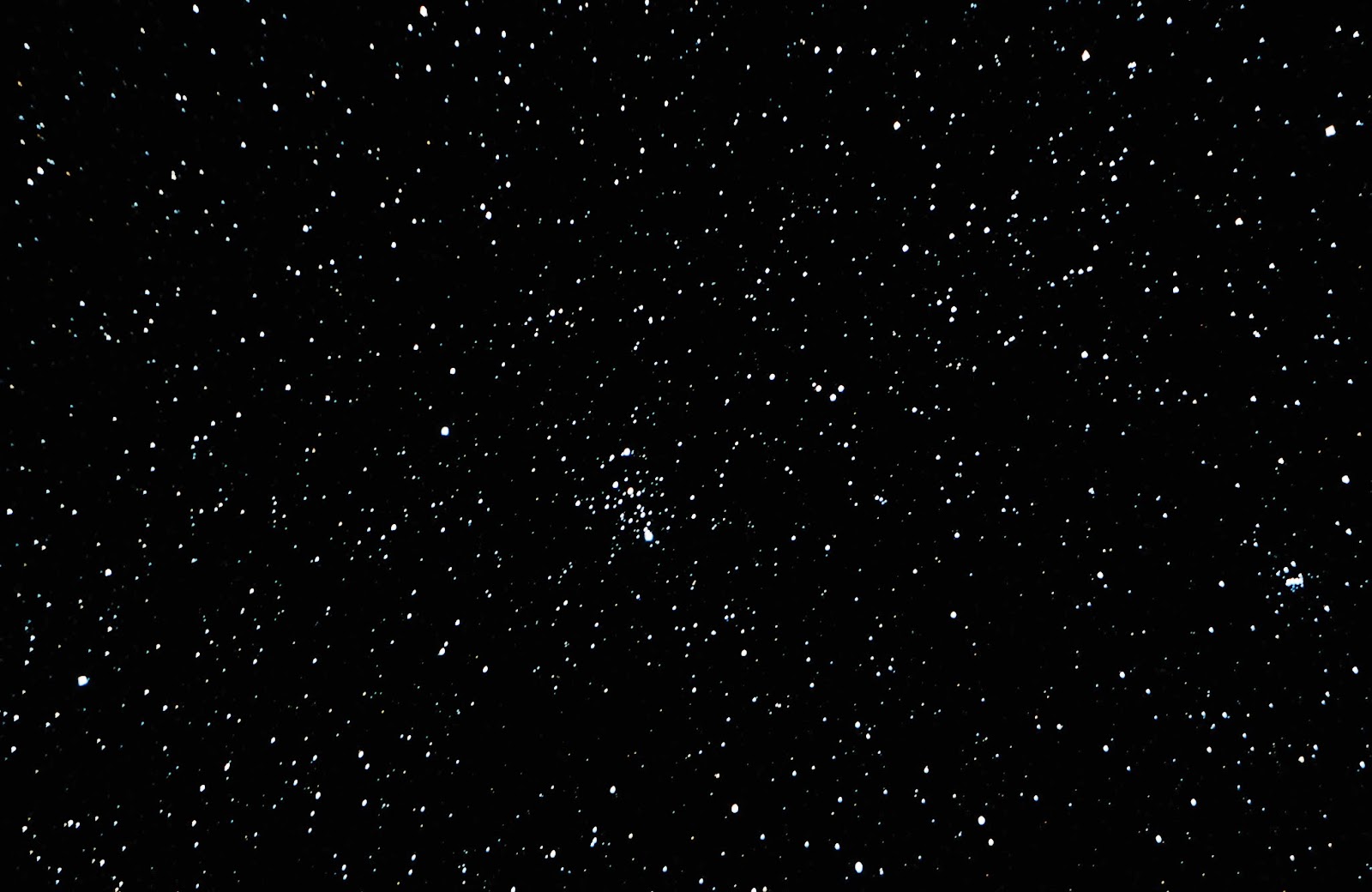
M-92 - Globular Cluster
Messier 92 is one of the few celestial objects that looks as good through the eyepiece as it does photographed. This is one of my summertime favorites as it is high in the sky, in Hercules, in July. Many compare it to the Great Globular Cluster in Hercules (M13), though this cluster is much smaller and less appreciated. Despite that, it does contain about 400,000 solar masses and is believed to be nearly as old as the universe itself. It also has an eccentric orbit around the galactic core and it's expected that in about 14,000 years it will lie within one degree of the celestial north pole.
Photo Details
July 16, 2014
Orion 8" Astrograph on VX Mount
Nikon D3100 Camera - ISO 1600
Baader MPC Mark III Multi-Purpose Coma Corrector
Skyglow filter
Autoguider
11 sub-frames at 3.0 minutes/frame
Total Exposure Time = 33 minutes
Image Stacking in Deep Sky Tracker
Image Processing in PhotoShop
Wednesday, June 18, 2014
M89, M90 (Spiral Galaxy) and IC 3606
We had a beautiful night at the Test Track to capture this image. Unfortunately, we did have some high clouds that seemed to have caused a bit of streaking. Despite that, I was pretty happy overall with the image. It represented my longest continuous run to date at nearly 4 total hours of exposure time. We also had a lot of fun looking for and seeing a few meteors as we got deeper into the night.
The main event in the photo is Messier 90 which is a face-on spiral galaxy somewhere between 30 and 65 million light years from us. I love the well-defined structure of the arms swirling about the bright core. Astronomers have determined about 2 new stars are born in the core every year, so it's a stellar nursery of sorts.
The second largest, and much less dramatic, object in the image is another galaxy, M89. Clearly outdone by the grand spiral design of its neighbor, this seemingly inconspicuous galaxy is 74,000 light years in diameter and hosts a super massive central object of a thousand million solar masses, which is probably a black hole.
The third largest object, I believe, is IC 3606. This is yet another galaxy found the galaxy-rich constellation of Virgo.
Photo Details
May 23, 2014
Orion 8" Astrograph on VX Mount
Nikon D3100 Camera - ISO 1600
Baader MPC Mark III Multi-Purpose Coma Corrector
Skyglow filter
Autoguider
78 sub-frames at 3.0 minutes/frame
Total Exposure Time = 3 hours 54 minutes
Image Stacking in Deep Sky Tracker
Image Processing in PhotoShop
Monday, May 26, 2014
M104-Sombrero Galaxy
The name of this galaxy speaks for itself and I find the most remarkable feature is the well-defined dark dust lane that bisects the galaxy. Astronomers report that these dust particles, many of which are micron in size, comprise an estimated mass of at least 10 million suns. Another amazing feature of this galaxy is the massive black hole at its center which contains an estimated thousand million solar masses.
Photo Details
May 18-19, 21, 2014
Orion 8" Astrograph on VX Mount
Nikon D3100 Camera - ISO 1600
Baader MPC Mark III Multi-Purpose Coma Corrector
Skyglow filter
Autoguider
82 sub-frames at 1.5 minutes/frame
21 sub-frames at 3.0 minutes/frame
Total Exposure Time = 3 hours 7 minutes
Image Stacking in Deep Sky Tracker
Image Processing in PhotoShop
Friday, May 9, 2014
M101 - Pinwheel Galaxy
This massive galaxy is known as a textbook grand-design spiral. About 24 million light years away from us, it is nearly twice the size of our own Milky Way galaxy. If you look closely at the image, you may see numerous bluish clusters and red HIII regions along the arms. Though faint, astronomers estimate some of these knots hold 10 million suns. Staggering and amazing to think that the light from this galaxy began its journey here as the Earth was beginning to enter a series of ice ages and the great apes were spreading across the old world.
Photo Details
May 3-4, 2014
Orion 8" Astrograph on VX Mount
Nikon D3100 Camera - ISO 1600
Baader MPC Mark III Multi-Purpose Coma Corrector
Skyglow filter
Autoguider
100 sub-frames at 1.5 minutes/frame
Total Exposure Time = 2 hours 30 minutes
Image Stacking in Deep Sky Tracker
Image Processing in PhotoShop
Note: This was the first image taken over multiple nights.
Thursday, April 17, 2014
M44 - The Beehive
I was able to enjoy the absolute rarest of celestial alignments on April 16, 2014. I received a new piece of equipment and on the very same day had clear skies to try it out. This only happens maybe once or twice in a lifetime. I was able to image the Beehive Cluster in Praesepe, otherwise known as Messier 44. This magnificent cluster of stars has been known since classical times. The first recorded view through a telescope was made by Galileo himself in 1609 who remarked, "The so-called nebula is not a single star but consists of a mass of more than 40 stars." Today, astronomers estimate there are about 200 stars belonging to this cluster. My favorites are the clusters of three that look a bit like bees buzzing through the cosmos.
Photo Details
April 16, 2014
Orion 8" Astrograph on VX Mount
Nikon D3100 Camera - ISO 1600
Baader MPC Mark III Multi-Purpose Coma Corrector
Skyglow filter
Autoguider
27 sub-frames at 1.5 minutes/frame
Total Exposure Time = 40 mins 30 seconds
Image Stacking in Deep Sky Tracker
Image Processing in PhotoShop
Tuesday, April 8, 2014
Opposition of Mars
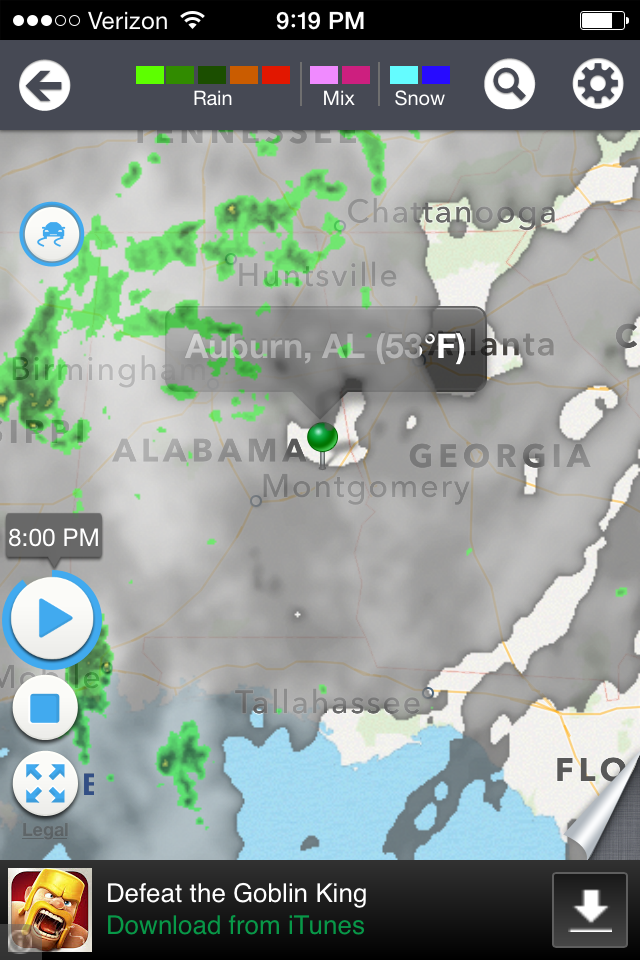
Tonight was the opposition of Mars, an event that only happens every two years when the sun, Earth and Mars form a straight line. We also are closer to Mars tonight than we've been in the last 6 1/2 years, approximately 57 million miles. As I was eagerly awaiting this event over the past few days, I was getting pretty dispirited about the weather forecast; cloudy with rain. Jen encouraged me not to give up, despite the heavy cloud cover this evening. So, I set up the 12" Dob on the deck and the clouds miraculously parted just as Mars cleared the tree line in my line of sight. Jen's hyper-vigilance once again influenced natural events. The radar image below shows I had a perfectly placed small window to see this event. Amazing! I've been doing so much astrophotography lately, I had forgotten the pure joy of looking through the eyepiece. I have never seen Mars look so stunning. A deep reddish hue fading into the polar ice cap. Stunning. I was gifted with about 40 minutes of good seeing before the clouds reclaimed the sky. Fleeting but fantastic.
Sunday, April 6, 2014
Messier 105 - Three Galaxies
It's been a tough few weeks for clear skies. My last attempt was on March 30th and was able to image Messier 105 (circular galaxy in image above). What makes M105 so special, of course, are the other nearby galaxies forming this tight right triangle. The oblong galaxy is NGC 3384 while the third galaxy that seems to have better structure is NGC 3389. Though M105 may appear simply as a fuzz-ball, it is massive as our own Milky Way galaxy.
Photo Details
March 30, 2014
Orion 8" Astrograph on VX Mount
Nikon D3100 Camera - ISO 1600
Coma Corrector & Skyglow filter
Autoguider
46 sub-frames at 1.5 minutes/frame
Total Exposure Time = 1 hour 7 minutes 30 seconds
Image Stacking in Deep Sky Tracker
Image Processing in PhotoShop
Sunday, March 2, 2014
Three Clusters
M34
M35 & NGC 2158
M38 & NGC 1907
Last Thursday, I was able to get out and capture three different star clusters in the Messier catalog. The first, M34, is one of the looser clusters in the Messier list. Can you picture the gorilla in the center? The next two, M35 and M38 are both rich in stars and feature companion clusters listed in the NGC. It's stunning to see so many stars in one view. Imagine all the companion planets that could be circling these distant suns!
M34
February 27, 2014
Orion 8" Astrograph on VX Mount
Nikon D3100 Camera - ISO 1600
Coma Corrector & Skyglow filter
Autoguider
9 sub-frames at 1.5 minutes/frame
Total Exposure Time = 13.5 minutes
Image Stacking in Deep Sky Tracker
Image Processing in PhotoShop
M35 & NGC 2158
February 27, 2014
Orion 8" Astrograph on VX Mount
Nikon D3100 Camera - ISO 1600
Coma Corrector & Skyglow filter
Autoguider
40 sub-frames at 1.5 minutes/frame
Total Exposure Time = 1 hour
Image Stacking in Deep Sky Tracker
Image Processing in PhotoShop
M38 & NGC 1907
February 27, 2014
Orion 8" Astrograph on VX Mount
Nikon D3100 Camera - ISO 1600
Coma Corrector & Skyglow filter
Autoguider
22 sub-frames at 1.5 minutes/frame
Total Exposure Time = 33 minutes
Image Stacking in Deep Sky Tracker
Image Processing in PhotoShop
Sunday, February 23, 2014
Eskimo Nebula
On Friday night we had reasonably good weather conditions and no moon so we made for our dark sight and went hunting for the Eskimo Nebula (NGC 2392). The nebula is known as a double-shell planetary nebula and resides in the constellation Gemini. It got its name for the outer shell of gas that looks a bit like a the furry trim of an Eskimo's parka. The other important fact about this object is that it's a planetary nebula which makes it a good target for am OIII filter as it gives of a particular wavelength of light. I was able to use my OIII and a 2x Barlow lens to get in relatively tight and bring up some nice resolution for this relatively small object. It will be fun next time to try without the OIII filter to see some true color.
Photo Details
February 21, 2014
Orion 8" Astrograph on VX Mount
Nikon D3100 Camera - ISO 1600
Barlow 2x lens
OIII filter
Autoguider
26 sub-frames at 3.0 minutes/frame
Total Exposure Time = 1 hour 18 minutes
Image Stacking in Deep Sky Tracker
Image Processing in PhotoShop
Monday, February 17, 2014
Seven Sisters
My first attempt at Messier 45 (Pleiades) was back in October. Since then, I've added taking flat frames, an autoguider and generally learned more techniques for post-processing. This image was an hour and 15 minutes of exposure time while the first one I shot was just 7.5 minutes. It was fun going back to a familiar sight to see what additional detail I could discover. Here they are, side-by-side...
February, 2014 October, 2013
Photo Details
February 15, 2014
Orion 8" Astrograph on VX Mount
Nikon D3100 Camera - ISO 1600
Coma Corrector & Orion Skyglow Filter
Autoguider
50 sub frames at 1.5 minutes/frame
Total Exposure Time = 1 hour 15 minutes
Image Stacking in Deep Sky Tracker
Image Processing in PhotoShop
Sunday, February 16, 2014
Sun
I had my first try photographing the sun yesterday with a new solar filter on my telescope. So much fun to see the incredible detail of the sunspots. To put things in perspective, our planet Earth would easily fit inside the single sunspot just right off the center of the sun.
Photo Details
February 15, 2014
Orion 8" Astrograph on VX Mount
Nikon D3100 Camera - ISO 400
Orion Solar Filter
Exposure time = 1/2500 seconds (photo 1 = 500 exposures; photo 2 = 300 exposures)
Image Stacking in Registax6
Image Processing in PhotoShop
Wednesday, February 5, 2014
Messier 78
Photo Details
January 30, 2014
Orion 8" Astrograph on VX Mount
Nikon D3100 Camera - ISO 1600
Coma Corrector & Orion Skyglow Filter
40 sub frames at 1.5 minutes/frame
Total Exposure Time = 1 hour
Image Stacking in Deep Sky Tracker
Image Processing in PhotoShop
Sunday, January 26, 2014
Three Diverse Sights
C31 - Flaming Star Nebula
M81 & M82
NGC 2264 - Christmas Tree Cluster & Cone Nebula
The first two photos above were shot at my dark sky site. A gorgeously clear, but very cold, night. We began imaging at 24F (7 PM) and finished up at 21F around 11 PM. The last one was shot from home and suffered from a lot of light pollution. It would be fun to try again from a dark sight.
The flaming start nebula (C31) is a very large emission/reflection nebula. This was one of those photos I took on pure faith. A few marker stars that told me I was on target, but I couldn't see any of the nebulosity until I got into post-processing.
M81 & 82 are a beautiful pair of galaxies about 11.5 million light years away. Messier 81 is the face on galaxy and has the classic "grand design" structure. Messier 82 is the smaller of the two and is known as a star-burst galaxy. Interestingly, the two interact with each other and the active star formation going on in M82 has resulted from interactions with M81. Near the core of of M81 there are more stars being formed than in all of our Milky Way.
The last photo is the Christmas Tree Cluster and the Cone Nebula. The Christmas Tree is plain to see, but the nebulosity is much tougher. Again, one of the photos I took on faith. The cone nebula is near the top of the tree and points downward toward the tree.
Photo Details
C31 - Flaming Star Nebula
January 24, 2014
Orion 8" Astrograph on VX Mount
Nikon D3100 Camera - ISO 1600
Coma Corrector & Orion Skyglow Filter
50 sub frames at 1.5 minutes/frame
Total Exposure Time = 1 hour 15 minutes
Image Stacking in Deep Sky Tracker
Image Processing in PhotoShop
Messier 81 & 82
January 24, 2014
Orion 8" Astrograph on VX Mount
Nikon D3100 Camera - ISO 1600
Coma Corrector & Orion Skyglow Filter
59 sub frames at 1.5 minutes/frame
Total Exposure Time = 1 hour 28 minutes 30 seconds
Image Stacking in Deep Sky Tracker
Image Processing in PhotoShop
NGC 2264 - Christmas Tree Cluster and Cone Nebula
January 20, 2014
Orion 8" Astrograph on VX Mount
Nikon D3100 Camera - ISO 1600
Coma Corrector & Orion Skyglow Filter
120 sub frames at 1.5 minutes/frame
Total Exposure Time = 3 hours
Image Stacking in Deep Sky Tracker
Image Processing in PhotoShop
Sunday, January 19, 2014
Rosette Nebula
The Rosette Nebula is one of the most stunning heavenly sights, but nearly impossible to see visually through a telescope. It is known as an emission nebula with active star formation in the center. This star formation heats the surrounding gas to 6 million kelvins generates vast amounts of x-rays in addition to the light we see in this image. Simply stunning!
Photo Details
Rosette Nebula - NGC 2237
January 18, 2014
Orion 8" Astrograph on VX Mount
Nikon D3100 Camera - ISO 1600
Coma Corrector & Orion Skyglow Filter
32 sub frames at 1.5 minutes/frame
Total Exposure Time = 48 minutes
Image Stacking in Deep Sky Tracker
Image Processing in PhotoShop
Friday, January 17, 2014
Tuesday, January 7, 2014
Pristine Sky
Horsehead & Flame Nebulae
Flame Nebula
Moon
Messier 77
On the night of January 3, we had extremely good conditions and I was able to meet up with a fellow astrophotographer at my dark sky site for a great imaging session.
The Horsehead and Flame Nebulae, to me, are absolutely stunning, but are a good lesson in patience. Each had over an hour of exposure time and I had to work extremely hard to tease out the details. It will be fun to go back and attempt these targets again with more time.
The moon was gorgeous as well with just a sliver visible as we were setting up and it set around 7:45 pm. I don't often get to photograph the moon this early in the cycle, which made it especially fun to capture.
The last photo, M77, is another galaxy in the Messier list. I definitely need to use more magnification in the future on this one!
Horsehead & Flame Nebula
January 3, 2014
Orion 8" Astrograph on VX Mount
Nikon D3100 Camera - ISO 1600
Coma Corrector & Orion Skyglow Filter
32 sub frames at 1.5 minutes/frame
Total Exposure Time = 48 minutes
Image Stacking in Deep Sky Tracker
Image Processing in PhotoShop
Flame Nebula
January 3, 2014
Orion 8" Astrograph on VX Mount
Nikon D3100 Camera - ISO 1600
Coma Corrector & Orion Skyglow Filter
32 sub frames at 1.5 minutes/frame
Total Exposure Time = 48 minutes
Image Stacking in Deep Sky Tracker
Image Processing in PhotoShop
9.3% Waxing Moon
January 3, 2014
Orion 8" Astrograph on VX Mount
Nikon D3100 Camera - ISO 800
Image Stacking in Registax6
Final processing in PhotoShop
Messier 77
January 3, 2014
Orion 8" Astrograph on VX Mount
Nikon D3100 Camera - ISO 1600
Coma Corrector
40 sub frames at 1.5 minutes/frame
Total Exposure Time = 60 minutes
Image Stacking in Deep Sky Tracker
Image Processing in PhotoShop
Monday, December 30, 2013
Messier 103
Messier 103 was the last entry in the original Messier list and is the farthest object in the list. I was lucky last evening to photograph this one. Clouds were coming in fast and I was mostly wanting to try out some new gadgets I had gotten for Christmas. This was my first attempt using the Coma Corrector, Skyglow filter and camera controller.
Photo Details
Messier 103
December 29, 2013
Orion 8" Astrograph on VX Mount
Nikon D3100 Camera - ISO 1600
Coma Corrector & Orion Skyglow Filter
8 sub frames at 1.5 minutes/frame
Total Exposure Time = 12 minutes
Image Stacking in Deep Sky Tracker
Image Processing in Fitswork
Friday, December 27, 2013
M1-Crab Nebula
The Crab Nebula is the first object in the Messier list, recorded by Messier in 1758. However, there are records of it on July 4th, 1054 when it was visible to the naked eye in Italy, Armenia, Iraq, China, Japan and North America. Of course, they could not see the nebulosity in this photo, but it was rather seen as a bright star observable even during the daytime. It is now known as Supernova Remnant which is why it was observable so long ago. This star literally blew up and we are looking at the remnants.
Photo Details
Messier 1
December 24, 2013
Orion 8" Astrograph on VX Mount
Nikon D3100 Camera - ISO 1600
90 sub frames at 30"/frame
Total Exposure Time = 45 minutes
Image Stacking in Deep Sky Tracker
Image Processing in Fitswork
Friday, December 20, 2013
Moon
Mare Imbrium
Pythagoras Crater
Mare Tranquillitatis and Mare Crisium
Photo Details
98.3% Full Moon
December 15, 2013
Orion 8" Astrograph on VX Mount
2x Barlow Lens nested with another 2x Barlow Lens
Nikon D3100 Camera - ISO 800
Image Stacking in Registax6
Final processing in PhotoShop
Wednesday, December 18, 2013
Moon
Cold nights. Clear skies. Full moon. The most wonderful time of the year is upon us!
98.3% Full Moon
December 15, 2013
Orion 8" Astrograph on VX Mount
2x Barlow Lens
Nikon D3100 Camera - ISO 800
481 sub frames at 1/1000"/frame
Image Stacking in Registax6
Final processing in PhotoShop
Subscribe to:
Posts (Atom)