Saturday, December 19, 2015

Pacman and Messier 39


NGC 281 - Pacman Nebula

Messier 39

The two images above are a study in contrasts.  Both set in very dense starfields, the top photo can be found in Cassiopeia and the gassy Pacman-shaped cloud is lit up by the bright central star.  The lower photo (Messier 39) is found in the constellation Cygnus and may be seen with the naked eye from dark locations.  To me, it looks like a beautiful set of jewels set against the majestic backdrop of the milky way.

NGC 281 (Pacman Nebula) - Photo Details
December 14-15, 2015
Orion 8" Astrograph on VX Mount
SBIG STF-8300C Camera
Baader MPC Mark III Multi-Purpose Coma Corrector
Skyglow filter
67 subframes at 3 minutes/frame
Total Exposure Time = 3 hours 21 minutes
Image Acquisition in CCDOps
Image Stacking in Deep Sky Tracker
Image Processing in PhotoShop

Messier 39 - Photo Details
December 14-15, 2015
Orion 8" Astrograph on VX Mount
SBIG STF-8300C Camera
Baader MPC Mark III Multi-Purpose Coma Corrector
Skyglow filter
27 subframes at 3 minutes/frame
Total Exposure Time = 1 hour 21 minutes
Image Acquisition in CCDOps
Image Stacking in Deep Sky Tracker
Image Processing in PhotoShop

Wednesday, November 25, 2015

Galaxies Galore and E.T.

Messier 31 - Andromeda Galaxy

NGC 457 (E.T. Cluster)

NGC 6946 (Fireworks Galaxy)

I normally add some descriptions regarding the above images.  But I thought a nice change of pace would be to post some song lyrics that perfectly fit this time of year as the winter constellations come soaring into view.  These come from the band Beta Radio on their Darden Road album.  You can here the song at https://www.youtube.com/watch?v=k1f-ieI1Ols


Both the bears are in their chairs
They're sitting in your upper room
Each night they ascend the stairs
And point to the north with dipping spoons
I hear the seven sisters whisper
they know the place from where they came
Oh the hunter and the bull
Are made full beneath the lion's mane

Oh, all the stars align
for the second time
Oh, I drank the new design
for the second time

The brother twins each other lend
A hand around the upper pole
They drink the wine of the new design
That makes the broken-hearted whole
The dragon came as he did before
Tempting all into his door
He wears stars as his disguise
But a second time he will not rise

Oh, all the stars align
for the second time
Oh, I drank the new design
for the second time

Oh, Oh, Oh, Oh    


M31 (Andromeda Galaxy) - Photo Details
November 19, 2015
Orion 8" Astrograph on VX Mount
SBIG STF-8300C Camera
Baader MPC Mark III Multi-Purpose Coma Corrector
Skyglow filter
48 subframes at 3 minutes/frame
Total Exposure Time = 2 hours 24 minutes
Image Acquisition in CCDOps
Image Stacking in Deep Sky Tracker
Image Processing in PhotoShop

NGC 457 - Photo Details
November 13, 2015
Orion 8" Astrograph on VX Mount
SBIG STF-8300C Camera
Baader MPC Mark III Multi-Purpose Coma Corrector
Skyglow filter
10 subframes at 3 minutes/frame
Total Exposure Time = 30 minutes
Image Acquisition in CCDOps
Image Stacking in Deep Sky Tracker
Image Processing in PhotoShop

NGC 6946 (Firework Galaxy) - Photo Details
October 18-19, 2015
Orion 8" Astrograph on VX Mount
SBIG STF-8300C Camera
Baader MPC Mark III Multi-Purpose Coma Corrector
Skyglow filter
67 subframes at 3 minutes/frame
Total Exposure Time = 3 hours 21 minutes
Image Acquisition in CCDOps
Image Stacking in Deep Sky Tracker
Image Processing in PhotoShop

Saturday, October 17, 2015

Two Globs Around a Dumbbell (M71, M27 & M56)

Messier 71

Messier 27 - Dumbbell Nebula

Messier 56

After a long, hot and humid summer, I finally had some crystal clear skies last week and made the most of it.  Messier 71 & 56 were new targets while I had imaged Messier 27 (Dumbbell) a couple years ago.  M27 is such a beautiful target, it was fun to revisit.  

M71 & 56 are both globular clusters comprised of tens of thousands of stars, they look completely different mostly due to their relative distance to Earth and proximity to the Milky Way. Messier 71 lies within the Milky Way and is set against a beautiful dense background of stars while M56 is a bit more concentrated and enjoys a bit more isolated area of space.

The dumbbell nebula is stunning to view.  It's amazing that such order, structure and beauty can evolve out of a dying star. 


M71 - Photo Details
October 13, 2015
Orion 8" Astrograph on VX Mount
SBIG STF-8300C Camera
Baader MPC Mark III Multi-Purpose Coma Corrector
Skyglow filter
29 subframes at 3 minutes/frame
Total Exposure Time = 1 hour 27 minutes
Image Acquisition in CCDOps
Image Stacking in Deep Sky Tracker
Image Processing in PhotoShop

M27 - Photo Details
October 12, 2015
Orion 8" Astrograph on VX Mount
SBIG STF-8300C Camera
Baader MPC Mark III Multi-Purpose Coma Corrector
Skyglow filter
37 subframes at 3 minutes/frame
Total Exposure Time = 1 hour 51 minutes
Image Acquisition in CCDOps
Image Stacking in Deep Sky Tracker
Image Processing in PhotoShop

M56 - Photo Details
October 6, 2015
Orion 8" Astrograph on VX Mount
SBIG STF-8300C Camera
Baader MPC Mark III Multi-Purpose Coma Corrector
Skyglow filter
30 subframes at 3 minutes/frame
Total Exposure Time = 1 hour 30 minutes
Image Acquisition in CCDOps
Image Stacking in Deep Sky Tracker
Image Processing in PhotoShop

Sunday, June 28, 2015

NGC 4725

This galaxy is somewhat unusual in that it just has a single spiral arm.  Most spiral galaxies, like our own Milky Way, have two arms.  A quick internet search showed that this is a very popular astrophotography target, but didn't turn up much beyond the facts that it spans about 100,000 light years and is approximately 41 million light years from earth.  There are two other galaxies in this image.  NGC 4712 is closes while NGC 4747 looks to me like it's hurling toward the others with just a hint of afterburner.

Photo Details
June 16 & 21, 2015
Orion 8" Astrograph on VX Mount
SBIG STF-8300C Camera
Baader MPC Mark III Multi-Purpose Coma Corrector
Skyglow filter
38 subframes at 3 minutes/frame
Total Exposure Time = 1 hour 54 minutes
Image Acquisition in CCDOps
Image Stacking in Deep Sky Tracker
Image Processing in PhotoShop

Saturday, June 6, 2015

Messier 53


After targeting primarily galaxies recently, I decided to check out a globular cluster last evening.  Messier 53 lies about 63,000 light years from us and, according to astronomers, is approaching at 70 km/sec.  That translates to a whopping 156,492 miles/hour.  Given the current distance and speed, Earth should have a close encounter in about 275 million years with this beautiful cluster.

Photo Details
June 5, 2015
Orion 8" Astrograph on VX Mount
SBIG STF-8300C Camera
Baader MPC Mark III Multi-Purpose Coma Corrector
Skyglow filter
19 subframes at 3 minutes/frame
Total Exposure Time = 57 minutes
Image Acquisition in CCDOps
Image Stacking in Deep Sky Tracker
Image Processing in PhotoShop

Thursday, June 4, 2015

Messier 106


We had a rare clear and cool Friday night with little moon on May 22.  Allison and I made the most of it and headed to our local dark site.  We had a great time, setting up at dusk and heading home at 1:30 in the morning.  While I was busy with the photography equipment, she did a great job running the large telescope herself and was able to see many new Messier objects.  In all, she logged 12 new ones and is well on her way to logging all 110.  Truly a night to remember.

The large galaxy in the image above is Messier 106 which, curiously, Messier may not have ever actually observed.  It was only added to the Messier list in 1948.  Other galaxies are clearly visible in the vicinity and astronomers believe M106 is the the center of a galaxy group of 17 objects.  The nearest and seemingly largest neighbor is NGC 4217 which happens to appear edge-on to our viewpoint.  The contrast and arrangement of these galaxies is simply stunning.

Photo Details
May 22, 2015
Orion 8" Astrograph on VX Mount
SBIG STF-8300C Camera
Baader MPC Mark III Multi-Purpose Coma Corrector
Skyglow filter
30 subframes at 5 minutes/frame
Total Exposure Time = 2 hour 30 minutes
Image Acquisition in CCDOps
Image Stacking in Deep Sky Tracker
Image Processing in PhotoShop

Sunday, May 10, 2015

Messier 65 and Messier 66


This pair of galaxies resides in the constellation Leo that rides high in the southern sky, leading Virgo toward the west.  The galaxy to the left is M65 while M66 is on the right.  They are similar in size, about 90,000 light years across, though M65 is inclined at about 74 degrees to our line of sight making it look much more elongated.  While these do make a stunning pair, there is actually a third I wasn't able to get in a single shot that together comprise the "Leo Triplet".  

Photo Details
May 6-7, 2015
Orion 8" Astrograph on VX Mount
SBIG STF-8300C Camera
Baader MPC Mark III Multi-Purpose Coma Corrector
Skyglow filter
22 sub-frames at 3 minutes/frame
Total Exposure Time = 1 hour 6 minutes
Image Acquisition in CCDOps
Image Stacking in Deep Sky Tracker
Image Processing in PhotoShop

Saturday, May 9, 2015

Messier 100


Spring is the time for galaxies in the southern part of the sky and though we've had tremendous cloud cover, we finally had a nice stretch of clear weather.  I was able to get out a few nights last week with a new camera (see notes below) and had a lot of fun shooting images at -15C with an entirely different setup.  So, this is essentially "first light" for the new setup.  I think M100 was a beautiful target, graced by a number of additional nearby galaxies.  While appearing somewhat small in this image, consider that it is 107,000 light years across and contains 200,000 million solar masses.  This is comparable to our own Milky Way galaxy.  It's irregular spiral shape has been attributed to gravitational interactions with the nearby galaxies.

Photo Details
May 6-7, 2015
Orion 8" Astrograph on VX Mount
SBIG STF-8300C Camera
Baader MPC Mark III Multi-Purpose Coma Corrector
Skyglow filter
38 sub-frames at 3 minutes/frame
Total Exposure Time = 1 hour 54 minutes
Image Acquisition in CCDOps
Image Stacking in Deep Sky Tracker
Image Processing in PhotoShop

Wednesday, February 25, 2015

Messier 41


On the same night I visited the Orion Nebula (below), I also took advantage of the clear skies to target Messier 41.  The loose arrangement of stars in the foreground is a naked eye collection that may be one of the oldest documented deep sky objects.  Aristotle made reference in 325 B.C. to a "tail" near one of the stars in the Dog.  Some modern astronomers believe he was referencing this collection as it resides in Canis Major (the Great Dog).  See if you can find it yourself.  First, go outside and find Canis Major.  You will find this trusty hunting dog following Orion as he hunts.  Look to the east and south of Orion to find the brightest star in the sky (Sirius) which is the eye of Canis Major.  Look just a little bit down (mostly south) from Sirius to see if you can see this cluster.

Photo Details
February 19, 2015
Orion 8" Astrograph on VX Mount
Nikon D3100 Camera - ISO 1600
Baader MPC Mark III Multi-Purpose Coma Corrector
Skyglow filter
40 sub-frames at 1.5 minutes/frame
Total Exposure Time = 1 hour
Image Stacking in Deep Sky Tracker
Image Processing in PhotoShop

Monday, February 23, 2015

Orion Nebula Revisited

Orion Nebula - 2/19/2015

Orion Nebula - 11/27/2013


After some time away from photographing the Orion Nebula, I decided to revisit a few nights ago.  What a difference a couple years of study, improved patience and equipment improvements will make!  The top image is the recent photo, while the lower was taken in November of 2013 for comparison.  Key differences with the new photo include more exposure time, using the full array of assorted frames (light, dark, flat, dark flat and bias), better understanding of post-processing, a more effective coma corrector and sky glow filter.  I also did a better job of framing the Orion Nebula and its neighbor, the Running Man.  This one is going on the wall!

Photo Details
February 19, 2015
Orion 8" Astrograph on VX Mount
Nikon D3100 Camera - ISO 1600
Baader MPC Mark III Multi-Purpose Coma Corrector
Skyglow filter
61 sub-frames at 1.5 minutes/frame
Total Exposure Time = 1 hour 31.5 minutes
Image Stacking in Deep Sky Tracker
Image Processing in PhotoShop

Thursday, February 12, 2015

California Nebula (NGC 1499)


The California Nebula (NGC 1499) now holds the record for the largest deep space object I've photographed.  This sprawling emission nebula is lit up by the by star in the lower center of the picture.  The nebula is so large that only about half of it is captured in this photo, the rest extends up and to the right and down and to the left.  Though appearing quite bright in this photo, at the eyepiece and in raw images there really isn't much to see.  It definitely requires a series of long exposures and some careful post processing to tease out the faint nebula structure.  

Photo Details
February 11, 2015
Orion 8" Astrograph on VX Mount
Nikon D3100 Camera - ISO 1600
Baader MPC Mark III Multi-Purpose Coma Corrector
Skyglow filter
Autoguider
45 sub-frames at 3.0 minutes/frame
Total Exposure Time = 2 hours 15 minutes
Image Stacking in Deep Sky Tracker
Image Processing in PhotoShop

Wednesday, February 11, 2015

Cave Nebula (Caldwell 9)

Another nebula I photographed over the holidays, but just now had a chance to process, was the Cave Nebula (C9).  This sprawling nebula complex contains emission, reflection and dark nebula.  The stars in this region are relatively young, some less than 100,000 years.    

Photo Details
December 11, 2014
Orion 8" Astrograph on VX Mount
Nikon D3100 Camera - ISO 1600
Baader MPC Mark III Multi-Purpose Coma Corrector
Skyglow filter
Autoguider
58 sub-frames at 3.0 minutes/frame
Total Exposure Time = 2 hours 54 minutes
Image Stacking in Deep Sky Tracker
Image Processing in PhotoShop

Tuesday, February 10, 2015

Cocoon Nebula (IC 5146)


The aptly named cocoon nebula lies in the constellation Cyngus.  It is both an emission nebula (gives off its own light as ionized gas) and reflection nebula (reflects light from other stars).  There is also a dark nebula trailing behind the cocoon, arcing up and to the right. To me the overall effect is simply stunning as the cocoon appears to have burrowed deep within this incredibly dense star field to await its metamorphosis.  

Photo Details
November 19, 2014
Orion 8" Astrograph on VX Mount
Nikon D3100 Camera - ISO 1600
Baader MPC Mark III Multi-Purpose Coma Corrector
Skyglow filter
Autoguider
76 sub-frames at 2.0 minutes/frame
Total Exposure Time = 2 hours 32 minutes
Image Stacking in Deep Sky Tracker
Image Processing in PhotoShop

Friday, January 30, 2015

Stars and Mythology

I wanted to thank Mrs. Barnes and all her bright students in Language Arts during their static period for having some fun today talking about constellations and mythology!  I hope you all have a chance this weekend to get outside and look up at the stars.  For those interested, the computer program I was using today is free and can be installed on any computer or device (iPhone, kindle, etc.).  Just search for "Stellarium" and have fun discovering the night sky.
Clear skies!

Saturday, January 17, 2015

Comet Lovejoy


A near naked eye comet is currently arcing high overhead.  If you are in a dark location and know where to look, you will definitely see comet Lovejoy (C/2014 Q2).  On January 7, was about halfway between the Sun and Earth.  It orbits the sun about every 8,000 to 11,000 years, so be sure and get a look if you can!  This is my first comet to photograph and it was interesting to track the comet rather than the background stars.  You can see some blurring of the background stars since the comet is much closer and on the move!

Photo Details
January 16, 2015
Orion 8" Astrograph on VX Mount
Nikon D3100 Camera - ISO 1600
Baader MPC Mark III Multi-Purpose Coma Corrector
Skyglow filter
Autoguider tracking the comet
10 sub-frames at 3.0 minutes/frame
Total Exposure Time = 30 minutes
Image Stacking in Deep Sky Tracker
Image Processing in PhotoShop

Sunday, November 30, 2014

Eastern Veil Nebula (NGC 6992)


The counterpart to the Western Veil Nebula, posted below, is the Eastern Veil Nebula (above).  While the other resembles a witch's broom, I feel like this one looks a bit like the claw of some otherworldly creature.  Taken together, they are simply magnificent.

Photo Details
October 24, 2014
Orion 8" Astrograph on VX Mount
Nikon D3100 Camera - ISO 1600
Baader MPC Mark III Multi-Purpose Coma Corrector
Skyglow filter
Autoguider
39 sub-frames at 3.0 minutes/frame
Total Exposure Time = 1 hour 57 minutes
Image Stacking in Deep Sky Tracker
Image Processing in PhotoShop

Sunday, September 28, 2014

Western Veil Nebula (NGC 6960)


High in the sky at this time of year is the constellation Cygnus - the Swan.  Lying within Cygnus is the gorgeous Veil Nebula that is so large it has been broken into Western and Eastern components.  The picture above constitutes most of the Western Veil (NGC 6960).   What we see is a cloud of ionized and superheated gas that is left over from a star that went supernova (stellar explosion) around 5,000 to 8,000 years ago.  It's easy to see why some refer to this as the Witch's Broom nebula and if you look closely, you can see a lot of structure that resembles filaments of light that even appear to be intertwined.  It's amazing to see the resemblance of this structure to that of DNA.  

Photo Details
September 22, 2014
Orion 8" Astrograph on VX Mount
Nikon D3100 Camera - ISO 1600
Baader MPC Mark III Multi-Purpose Coma Corrector
Skyglow filter
Autoguider
35 sub-frames at 3.0 minutes/frame
Total Exposure Time = 1 hour 45 minutes
Image Stacking in Deep Sky Tracker
Image Processing in PhotoShop

Wednesday, September 3, 2014

Messier 23, 25 & 26


Messier 23

Messier 25

Messier 26

The close proximity of these three objects in the night sky, located in the heart of the Milky Way in the constellation Sagittarius, enabled Messier to observe them for the first time in a single night (June 20, 1764).  It took me a bit longer to photograph them over the course of two nights last week.  The objects themselves are simply overwhelmed by the glorious backdrop of thousands of stars.  It's remarkable that Messier was able to discern these clusters given the rest of the view!  At first glance, they look quite similar.  But, if you focus your attention toward the center of each, you will see distinctly different clusters.  I find it simply amazing that there really are no complete duplicates of anything in the universe.  Each creation has its own distinct characteristics though governed by the same basic laws of physics.

Messier 23
August 26, 2014
Orion 8" Astrograph on VX Mount
Nikon D3100 Camera - ISO 1600
Baader MPC Mark III Multi-Purpose Coma Corrector
Skyglow filter
Autoguider
19 sub-frames at 3.0 minutes/frame
Total Exposure Time = 57 minutes
Image Stacking in Deep Sky Tracker
Image Processing in PhotoShop

Messier 25
August 27, 2014
Orion 8" Astrograph on VX Mount
Nikon D3100 Camera - ISO 1600
Baader MPC Mark III Multi-Purpose Coma Corrector
Skyglow filter
Autoguider
22 sub-frames at 3.0 minutes/frame
Total Exposure Time = 1 hour 6 minutes
Image Stacking in Deep Sky Tracker
Image Processing in PhotoShop

Messier 26
August 26, 2014
Orion 8" Astrograph on VX Mount
Nikon D3100 Camera - ISO 1600
Baader MPC Mark III Multi-Purpose Coma Corrector
Skyglow filter
Autoguider
13 sub-frames at 3.0 minutes/frame
Total Exposure Time = 39 minutes
Image Stacking in Deep Sky Tracker
Image Processing in PhotoShop

Monday, August 25, 2014

Messier 17 and 11

Messier 17 - Omega or Swan Nebula

Messier 11 - Wild Duck Cluster


The constellation Sagittarius is brimming with beautiful sights in the heart of the Milky Way.  Messier 17 and 11, pictured above, are gorgeously set in incredibly dense star fields.  Messier 17, known as the Omega or Swan Nebula, is an active star forming region first observed by a Swiss observer in 1745 or 1746.  Charles Messier did not observe M17 until much later in 1764.  The Swan is much easier to recognize than the Omega, though Omega is the much more popular name.

Messier 11, the Wild Duck Cluster, was discovered much earlier in 1681 by a German astronomer and is known today as one of the most compact and richest galactic star clusters.  The description written by Admiral Smyth gives this cluster its modern name, "This object, which somewhat resembles a flight of wild ducks in shape, is a gathering of minute stars..."  I don't necessarily see the ducks, but it is a great name!

Messier 17 - Omega or Swan Nebula
August 16, 2014
Orion 8" Astrograph on VX Mount
Nikon D3100 Camera - ISO 1600
Baader MPC Mark III Multi-Purpose Coma Corrector
Skyglow filter
Autoguider
24 sub-frames at 3.0 minutes/frame
Total Exposure Time = 1 hour 12 minutes
Image Stacking in Deep Sky Tracker
Image Processing in PhotoShop

Messier 11 - Wild Duck Cluster
August 15, 2014
Orion 8" Astrograph on VX Mount
Nikon D3100 Camera - ISO 1600
Baader MPC Mark III Multi-Purpose Coma Corrector
Skyglow filter
Autoguider
21 sub-frames at 3.0 minutes/frame
Total Exposure Time = 1 hour 3 minutes
Image Stacking in Deep Sky Tracker
Image Processing in PhotoShop


Thursday, August 21, 2014

Messier 20 (Trifid Nebula) and Messier 21


I recently posted that Messier 8 with the Lagoon Nebula was my favorite summertime sight.  Well, I have another to add to the list.  Messier 20, otherwise known as the Trifid Nebula, is another stunning sight.  It's hard to tell exactly how "Trifid" was decided upon.  You can clearly see the two distinctly colored regions.  The reddish colored portion is an H-II region glowing in red hydrogen-alpha light while the bluish area is a reflection nebula.  As the name implies, it is literally clouds of interstellar dust that are reflecting the light.  So, if you count these two regions, perhaps it should be called the Bifid nebula?  Another approach is to look closely at the reddish portion as it appears to be divided into parts by dark, dusky lanes.  However, it appears to be divided into four.  So, should it be then called the Quadfid nebula?  Perhaps "Trifid" just had a nice ring to it and the name stuck.  This nebula, by galactic standards, is fairly young at under 400,000 years and, like many other nebulae, is an active star forming region.

The other main object in the photo, aside from the 5000+ stars, is Messier 21.  This one also suffers from its location relative to the much more spectacular M20.  It's in the upper left quadrant of the photo and resembles a diamond ring.  Can you spot it?

Messier 20 (Trifid Nebula) & Messier 21
August 14-15, 2014
Orion 8" Astrograph on VX Mount
Nikon D3100 Camera - ISO 1600
Baader MPC Mark III Multi-Purpose Coma Corrector
Skyglow filter
Autoguider
35 sub-frames at 3.0 minutes/frame
Total Exposure Time = 1 hour 45 minutes
Image Stacking in Deep Sky Tracker
Image Processing in PhotoShop

Wednesday, August 6, 2014

First Star Night

I wanted to thank everyone who joined us for our first Grove Hill star night!  It was great to meet everyone and share the beautiful (but muggy) night sky. We hope to make it a somewhat regular occurrence, perhaps as much as once a month.  If you are interested in getting some more advanced warning than just the signs that were posted outside, you can email me directly at timmastro@charter.net or use the form below in the sidebar to email me and I will start a little list.  I have no commercial interest at all with this so don't worry about me sharing your email with anyone else.  You can also just check back to this blog and I will try and update if the weather is looking good for another star night.  In any case, I hope you enjoyed it and will come back to see more!
Clear skies!

Sunday, August 3, 2014

M8 and M14


Messier 8 with the Lagoon Nebula

Messier 14


I officially have a new favorite summertime Messier object.  Just as the Orion Nebula (M42) rules the winter sky, so does Messier 8 with the Lagoon Nebula, located in Sagittarius.  This stunning sight is a young stellar cluster where stars are actively forming.  Messier 8 is the bright cluster of stars within the emission nebula.  The nebula was given the name "Lagoon" due to dark, dusky lane running through its center.  You might also notice numerous dark areas scattered through the nebula.  These so-called "dark nebula" are interstellar clouds that are so dense they obscure the light from the emission nebula.  Another gem in this nebula is the extremely bright hourglass shaped nebula to the right side of the lagoon.  Can you spot it?  One final note on M8.  As I was processing the image through my stacking software, I was noticing the star count reported during the stacking process.  Nearly 3,500 individual stars are within this photo.  Stunning.

The second photo is Messier 14 which suffers from having been taken on the same night as M8 and listed here with it.  Though seemingly far less impressive, it contains approximately 1.2 million solar masses and is a beautiful sight in its own right.


Photo Details

Messier 8 with the Lagoon Nebula

July 29, 2014
Orion 8" Astrograph on VX Mount
Nikon D3100 Camera - ISO 1600
Baader MPC Mark III Multi-Purpose Coma Corrector
Skyglow filter
Autoguider
19 sub-frames at 3.0 minutes/frame
Total Exposure Time = 1 hour 57 minutes
Image Stacking in Deep Sky Tracker
Image Processing in PhotoShop

Messier 14
July 29, 2014
Orion 8" Astrograph on VX Mount
Nikon D3100 Camera - ISO 1600
Baader MPC Mark III Multi-Purpose Coma Corrector
Skyglow filter
Autoguider
8 sub-frames at 3.0 minutes/frame
Total Exposure Time = 24 minutes
Image Stacking in Deep Sky Tracker
Image Processing in PhotoShop

Saturday, July 19, 2014

M-92 - Globular Cluster


Messier 92 is one of the few celestial objects that looks as good through the eyepiece as it does photographed.  This is one of my summertime favorites as it is high in the sky, in Hercules, in July.  Many compare it to the Great Globular Cluster in Hercules (M13), though this cluster is much smaller and less appreciated.  Despite that, it does contain about 400,000 solar masses and is believed to be nearly as old as the universe itself.  It also has an eccentric orbit around the galactic core and it's expected that in about 14,000 years it will lie within one degree of the celestial north pole.  

Photo Details
July 16, 2014
Orion 8" Astrograph on VX Mount
Nikon D3100 Camera - ISO 1600
Baader MPC Mark III Multi-Purpose Coma Corrector
Skyglow filter
Autoguider
11 sub-frames at 3.0 minutes/frame
Total Exposure Time = 33 minutes
Image Stacking in Deep Sky Tracker
Image Processing in PhotoShop

Wednesday, June 18, 2014

M89, M90 (Spiral Galaxy) and IC 3606


We had a beautiful night at the Test Track to capture this image.  Unfortunately, we did have some high clouds that seemed to have caused a bit of streaking.  Despite that, I was pretty happy overall with the image.  It represented my longest continuous run to date at nearly 4 total hours of exposure time.  We also had a lot of fun looking for and seeing a few meteors as we got deeper into the night.

The main event in the photo is Messier 90 which is a face-on spiral galaxy somewhere between 30 and 65 million light years from us.  I love the well-defined structure of the arms swirling about the bright core.  Astronomers have determined about 2 new stars are born in the core every year, so it's a stellar nursery of sorts.

The second largest, and much less dramatic, object in the image is another galaxy, M89.  Clearly outdone by the grand spiral design of its neighbor, this seemingly inconspicuous galaxy is 74,000 light years in diameter and hosts a super massive central object of a thousand million solar masses, which is probably a black hole.


The third largest object, I believe, is IC 3606.  This is yet another galaxy found the galaxy-rich constellation of Virgo.

Photo Details
May 23, 2014
Orion 8" Astrograph on VX Mount
Nikon D3100 Camera - ISO 1600
Baader MPC Mark III Multi-Purpose Coma Corrector
Skyglow filter
Autoguider
78 sub-frames at 3.0 minutes/frame
Total Exposure Time = 3 hours 54 minutes
Image Stacking in Deep Sky Tracker
Image Processing in PhotoShop

Monday, May 26, 2014

M104-Sombrero Galaxy


The name of this galaxy speaks for itself and I find the most remarkable feature is the well-defined dark dust lane that bisects the galaxy.  Astronomers report that these dust particles, many of which are micron in size, comprise an estimated mass of at least 10 million suns.  Another amazing feature of this galaxy is the massive black hole at its center which contains an estimated thousand million solar masses.

Photo Details
May 18-19, 21, 2014
Orion 8" Astrograph on VX Mount
Nikon D3100 Camera - ISO 1600
Baader MPC Mark III Multi-Purpose Coma Corrector
Skyglow filter
Autoguider
82 sub-frames at 1.5 minutes/frame
21 sub-frames at 3.0 minutes/frame
Total Exposure Time = 3 hours 7 minutes
Image Stacking in Deep Sky Tracker
Image Processing in PhotoShop

Friday, May 9, 2014

M101 - Pinwheel Galaxy


This massive galaxy is known as a textbook grand-design spiral. About 24 million light years away from us, it is nearly twice the size of our own Milky Way galaxy.  If you look closely at the image, you may see numerous bluish clusters and red HIII regions along the arms.  Though faint, astronomers estimate some of these knots hold 10 million suns.  Staggering and amazing to think that the light from this galaxy began its journey here as the Earth was beginning to enter a series of ice ages and the great apes were spreading across the old world.

Photo Details
May 3-4, 2014
Orion 8" Astrograph on VX Mount
Nikon D3100 Camera - ISO 1600
Baader MPC Mark III Multi-Purpose Coma Corrector
Skyglow filter
Autoguider
100 sub-frames at 1.5 minutes/frame
Total Exposure Time = 2 hours 30 minutes
Image Stacking in Deep Sky Tracker
Image Processing in PhotoShop
Note:  This was the first image taken over multiple nights.  

Thursday, April 17, 2014

M44 - The Beehive


I was able to enjoy the absolute rarest of celestial alignments on April 16, 2014.  I received a new piece of equipment and on the very same day had clear skies to try it out.  This only happens maybe once or twice in a lifetime.  I was able to image the Beehive Cluster in Praesepe, otherwise known as Messier 44.  This magnificent cluster of stars has been known since classical times.  The first recorded view through a telescope was made by Galileo himself in 1609 who remarked, "The so-called nebula is not a single star but consists of a mass of more than 40 stars."  Today, astronomers estimate there are about 200 stars belonging to this cluster.  My favorites are the clusters of three that look a bit like bees buzzing through the cosmos.

Photo Details
April 16, 2014
Orion 8" Astrograph on VX Mount
Nikon D3100 Camera - ISO 1600
Baader MPC Mark III Multi-Purpose Coma Corrector
Skyglow filter
Autoguider
27 sub-frames at 1.5 minutes/frame
Total Exposure Time = 40 mins 30 seconds
Image Stacking in Deep Sky Tracker
Image Processing in PhotoShop
Tuesday, April 8, 2014

Opposition of Mars

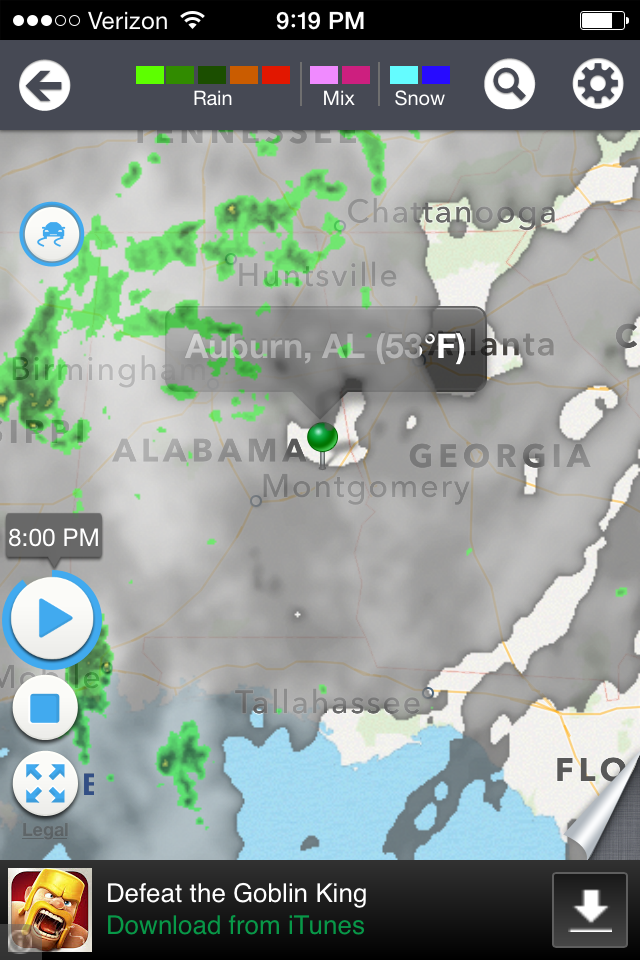
Tonight was the opposition of Mars, an event that only happens every two years when the sun, Earth and Mars form a straight line.  We also are closer to Mars tonight than we've been in the last 6 1/2 years, approximately 57 million miles.  As I was eagerly awaiting this event over the past few days, I was getting pretty dispirited about the weather forecast; cloudy with rain.  Jen encouraged me not to give up, despite the heavy cloud cover this evening.  So, I set up the 12" Dob on the deck and the clouds miraculously parted just as Mars cleared the tree line in my line of sight. Jen's hyper-vigilance once again influenced natural events. The radar image below shows I had a perfectly placed small window to see this event.  Amazing!  I've been doing so much astrophotography lately, I had forgotten the pure joy of looking through the eyepiece. I have never seen Mars look so stunning. A deep reddish hue fading into the polar ice cap. Stunning.  I was gifted with about 40 minutes of good seeing before the clouds reclaimed the sky.  Fleeting but fantastic.


Sunday, April 6, 2014

Messier 105 - Three Galaxies


It's been a tough few weeks for clear skies.  My last attempt was on March 30th and was able to image Messier 105 (circular galaxy in image above).  What makes M105 so special, of course, are the other nearby galaxies forming this tight right triangle.  The oblong galaxy is NGC 3384 while the third galaxy that seems to have better structure is NGC 3389.  Though M105 may appear simply as a fuzz-ball, it is massive as our own Milky Way galaxy.


Photo Details
March 30, 2014
Orion 8" Astrograph on VX Mount
Nikon D3100 Camera - ISO 1600
Coma Corrector & Skyglow filter
Autoguider
46 sub-frames at 1.5 minutes/frame
Total Exposure Time = 1 hour 7 minutes 30 seconds
Image Stacking in Deep Sky Tracker
Image Processing in PhotoShop

Sunday, March 2, 2014

Three Clusters

M34

M35 & NGC 2158

M38 & NGC 1907

Last Thursday, I was able to get out and capture three different star clusters in the Messier catalog.  The first, M34, is one of the looser clusters in the Messier list.  Can you picture the gorilla in the center?  The next two, M35 and M38 are both rich in stars and feature companion clusters listed in the NGC.   It's stunning to see so many stars in one view.  Imagine all the companion planets that could be circling these distant suns!

Photo Details
M34
February 27, 2014
Orion 8" Astrograph on VX Mount
Nikon D3100 Camera - ISO 1600
Coma Corrector & Skyglow filter
Autoguider
9 sub-frames at 1.5 minutes/frame
Total Exposure Time = 13.5 minutes
Image Stacking in Deep Sky Tracker
Image Processing in PhotoShop

M35 & NGC 2158
February 27, 2014
Orion 8" Astrograph on VX Mount
Nikon D3100 Camera - ISO 1600
Coma Corrector & Skyglow filter
Autoguider
40 sub-frames at 1.5 minutes/frame
Total Exposure Time = 1 hour
Image Stacking in Deep Sky Tracker
Image Processing in PhotoShop

M38 & NGC 1907
February 27, 2014
Orion 8" Astrograph on VX Mount
Nikon D3100 Camera - ISO 1600
Coma Corrector & Skyglow filter
Autoguider
22 sub-frames at 1.5 minutes/frame
Total Exposure Time = 33 minutes
Image Stacking in Deep Sky Tracker
Image Processing in PhotoShop


Sunday, February 23, 2014

Eskimo Nebula


On Friday night we had reasonably good weather conditions and no moon so we made for our dark sight and went hunting for the Eskimo Nebula (NGC 2392).  The nebula is known as a double-shell planetary nebula and resides in the constellation Gemini.  It got its name for the outer shell of gas that looks a bit like a the furry trim of an Eskimo's parka.  The other important fact about this object is that it's a planetary nebula which makes it a good target for am OIII filter as it gives of a particular wavelength of light.  I was able to use my OIII and a 2x Barlow lens to get in relatively tight and bring up some nice resolution for this relatively small object.  It will be fun next time to try without the OIII filter to see some true color.

Photo Details
February 21, 2014
Orion 8" Astrograph on VX Mount
Nikon D3100 Camera - ISO 1600
Barlow 2x lens
OIII filter
Autoguider
26 sub-frames at 3.0 minutes/frame
Total Exposure Time = 1 hour 18 minutes
Image Stacking in Deep Sky Tracker
Image Processing in PhotoShop

Monday, February 17, 2014

Seven Sisters


My first attempt at Messier 45 (Pleiades) was back in October.  Since then, I've added taking flat frames, an autoguider and generally learned more techniques for post-processing.  This image was an hour and 15 minutes of exposure time while the first one I shot was just 7.5 minutes.  It was fun going back to a familiar sight to see what additional detail I could discover.  Here they are, side-by-side...


                       February, 2014            October, 2013


Photo Details
February 15, 2014
Orion 8" Astrograph on VX Mount
Nikon D3100 Camera - ISO 1600
Coma Corrector & Orion Skyglow Filter
Autoguider
50 sub frames at 1.5 minutes/frame
Total Exposure Time = 1 hour 15 minutes
Image Stacking in Deep Sky Tracker
Image Processing in PhotoShop

Sunday, February 16, 2014

Sun


I had my first try photographing the sun yesterday with a new solar filter on my telescope.  So much fun to see the incredible detail of the sunspots.  To put things in perspective, our planet Earth would easily fit inside the single sunspot just right off the center of the sun.

Photo Details
February 15, 2014
Orion 8" Astrograph on VX Mount
Nikon D3100 Camera - ISO 400
Orion Solar Filter
Exposure time = 1/2500 seconds (photo 1 = 500 exposures; photo 2 = 300 exposures)
Image Stacking in Registax6
Image Processing in PhotoShop

Wednesday, February 5, 2014

Messier 78


Messier 78, and it's companion, NGC 2071, are located near Orion's belt and are considered part of the larger Orion Nebula complex.  M78 is the only principal reflection nebula in the Messier list.  The pair of stars in the nebula aren't powerful enough to ionize the gas in the cloud, so what we are seeing is simply reflected light on the dust particles in the nebula.  The cloud is blue because the stars in the center are young and blue.


Photo Details
January 30, 2014
Orion 8" Astrograph on VX Mount
Nikon D3100 Camera - ISO 1600
Coma Corrector & Orion Skyglow Filter
40 sub frames at 1.5 minutes/frame
Total Exposure Time = 1 hour
Image Stacking in Deep Sky Tracker
Image Processing in PhotoShop