Sunday, January 26, 2014

Three Diverse Sights

C31 - Flaming Star Nebula

M81 & M82

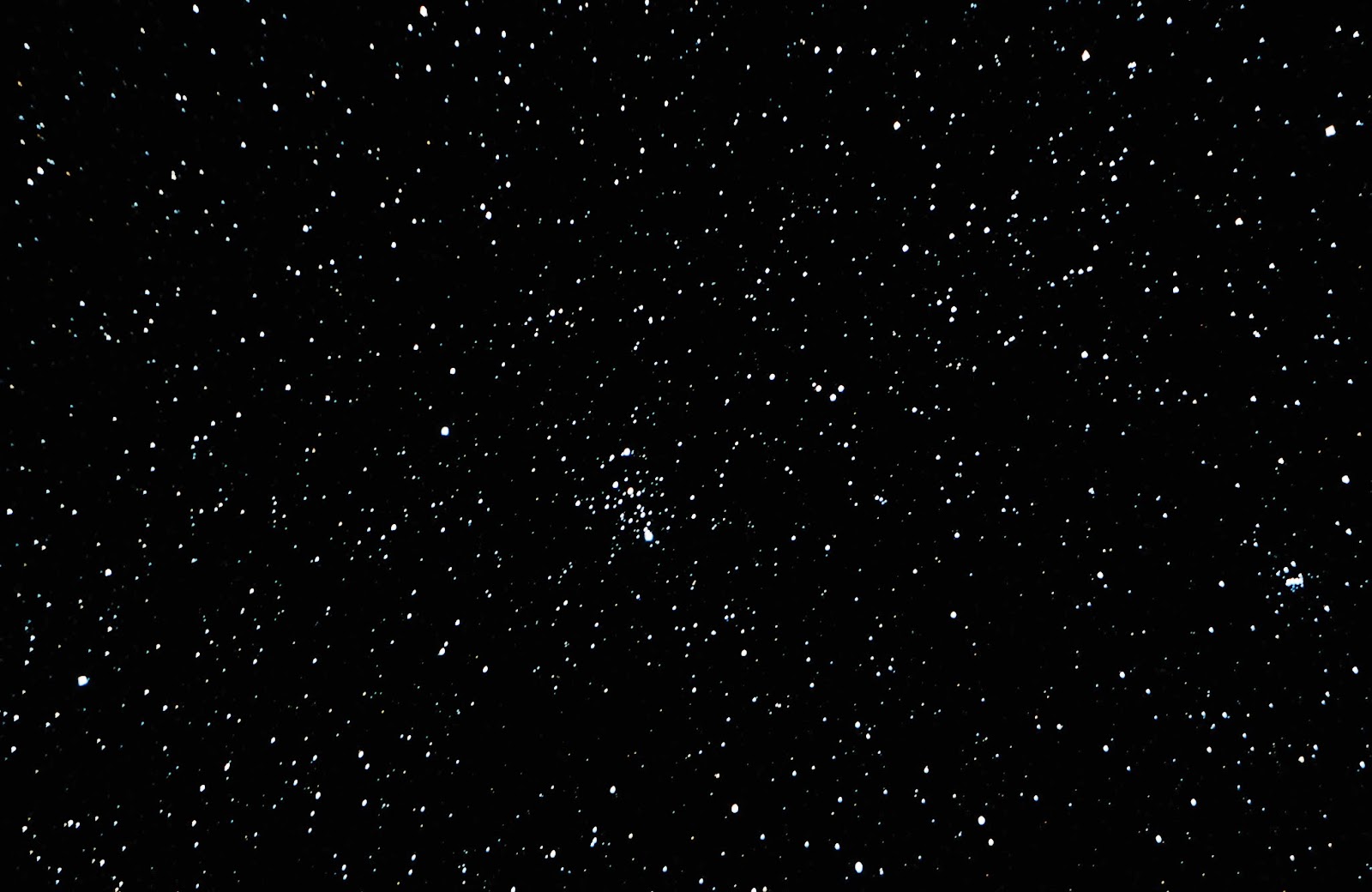
NGC 2264 - Christmas Tree Cluster & Cone Nebula

The first two photos above were shot at my dark sky site. A gorgeously clear, but very cold, night.  We began imaging at 24F (7 PM) and finished up at 21F around 11 PM.  The last one was shot from home and suffered from a lot of light pollution.  It would be fun to try again from a dark sight.

The flaming start nebula (C31) is a very large emission/reflection nebula.  This was one of those photos I took on pure faith.  A few marker stars that told me I was on target, but I couldn't see any of the nebulosity until I got into post-processing.

M81 & 82 are a beautiful pair of galaxies about 11.5 million light years away.  Messier 81 is the face on galaxy and has the classic "grand design" structure.  Messier 82 is the smaller of the two and is known as a star-burst galaxy.  Interestingly, the two interact with each other and the active star formation going on in M82 has resulted from interactions with M81.  Near the core of of M81 there are more stars being formed than in all of our Milky Way.

The last photo is the Christmas Tree Cluster and the Cone Nebula.  The Christmas Tree is plain to see, but the nebulosity is much tougher.  Again, one of the photos I took on faith.  The cone nebula is near the top of the tree and points downward toward the tree.  


Photo Details
C31 - Flaming Star Nebula
January 24, 2014
Orion 8" Astrograph on VX Mount
Nikon D3100 Camera - ISO 1600
Coma Corrector & Orion Skyglow Filter
50 sub frames at 1.5 minutes/frame
Total Exposure Time = 1 hour 15 minutes
Image Stacking in Deep Sky Tracker
Image Processing in PhotoShop

Messier 81 & 82
January 24, 2014
Orion 8" Astrograph on VX Mount
Nikon D3100 Camera - ISO 1600
Coma Corrector & Orion Skyglow Filter
59 sub frames at 1.5 minutes/frame
Total Exposure Time = 1 hour 28 minutes 30 seconds
Image Stacking in Deep Sky Tracker
Image Processing in PhotoShop

NGC 2264 - Christmas Tree Cluster and Cone Nebula
January 20, 2014
Orion 8" Astrograph on VX Mount
Nikon D3100 Camera - ISO 1600
Coma Corrector & Orion Skyglow Filter
120 sub frames at 1.5 minutes/frame
Total Exposure Time = 3 hours
Image Stacking in Deep Sky Tracker
Image Processing in PhotoShop

Sunday, January 19, 2014

Rosette Nebula


The Rosette Nebula is one of the most stunning heavenly sights, but nearly impossible to see visually through a telescope.  It is known as an emission nebula with active star formation in the center.  This star formation heats the surrounding gas to 6 million kelvins generates vast amounts of x-rays in addition to the light we see in this image.  Simply stunning!

Photo Details
Rosette Nebula - NGC 2237
January 18, 2014
Orion 8" Astrograph on VX Mount
Nikon D3100 Camera - ISO 1600
Coma Corrector & Orion Skyglow Filter
32 sub frames at 1.5 minutes/frame
Total Exposure Time = 48 minutes
Image Stacking in Deep Sky Tracker
Image Processing in PhotoShop

Friday, January 17, 2014

Tuesday, January 7, 2014

Pristine Sky

Horsehead & Flame Nebulae

Flame Nebula 

Moon

Messier 77

On the night of January 3, we had extremely good conditions and I was able to meet up with a fellow astrophotographer at my dark sky site for a great imaging session.

The Horsehead and Flame Nebulae, to me, are absolutely stunning, but are a good lesson in patience.  Each had over an hour of exposure time and I had to work extremely hard to tease out the details.  It will be fun to go back and attempt these targets again with more time.

The moon was gorgeous as well with just a sliver visible as we were setting up and it set around 7:45 pm.  I don't often get to photograph the moon this early in the cycle, which made it especially fun to capture.  

The last photo, M77, is another galaxy in the Messier list.  I definitely need to use more magnification in the future on this one!


Photo Details
Horsehead & Flame Nebula
January 3, 2014
Orion 8" Astrograph on VX Mount
Nikon D3100 Camera - ISO 1600
Coma Corrector & Orion Skyglow Filter
32 sub frames at 1.5 minutes/frame
Total Exposure Time = 48 minutes
Image Stacking in Deep Sky Tracker
Image Processing in PhotoShop

Flame Nebula
January 3, 2014
Orion 8" Astrograph on VX Mount
Nikon D3100 Camera - ISO 1600
Coma Corrector & Orion Skyglow Filter
32 sub frames at 1.5 minutes/frame
Total Exposure Time = 48 minutes
Image Stacking in Deep Sky Tracker
Image Processing in PhotoShop

9.3% Waxing Moon
January 3, 2014
Orion 8" Astrograph on VX Mount
Nikon D3100 Camera - ISO 800
Image Stacking in Registax6
Final processing in PhotoShop

Messier 77
January 3, 2014
Orion 8" Astrograph on VX Mount
Nikon D3100 Camera - ISO 1600
Coma Corrector
40 sub frames at 1.5 minutes/frame
Total Exposure Time = 60 minutes
Image Stacking in Deep Sky Tracker
Image Processing in PhotoShop


Monday, December 30, 2013

Messier 103


Messier 103 was the last entry in the original Messier list and is the farthest object in the list.  I was lucky last evening to photograph this one.  Clouds were coming in fast and I was mostly wanting to try out some new gadgets I had gotten for Christmas.  This was my first attempt using the Coma Corrector, Skyglow filter and camera controller.

Photo Details
Messier 103
December 29, 2013
Orion 8" Astrograph on VX Mount
Nikon D3100 Camera - ISO 1600
Coma Corrector & Orion Skyglow Filter
8 sub frames at 1.5 minutes/frame
Total Exposure Time = 12 minutes
Image Stacking in Deep Sky Tracker
Image Processing in Fitswork

Friday, December 27, 2013

M1-Crab Nebula


The Crab Nebula is the first object in the Messier list, recorded by Messier in 1758.  However, there are records of it on July 4th, 1054 when it was visible to the naked eye in Italy, Armenia, Iraq, China, Japan and North America.  Of course, they could not see the nebulosity in this photo, but it was rather seen as a bright star observable even during the daytime. It is now known as Supernova Remnant which is why it was observable so long ago.  This star literally blew up and we are looking at the remnants.


Photo Details
Messier 1
December 24, 2013
Orion 8" Astrograph on VX Mount
Nikon D3100 Camera - ISO 1600
90 sub frames at 30"/frame
Total Exposure Time = 45 minutes
Image Stacking in Deep Sky Tracker
Image Processing in Fitswork

Friday, December 20, 2013

Moon

Mare Imbrium

Pythagoras Crater

Mare Tranquillitatis and Mare Crisium

Photo Details
98.3% Full Moon
December 15, 2013
Orion 8" Astrograph on VX Mount
2x Barlow Lens nested with another 2x Barlow Lens
Nikon D3100 Camera - ISO 800
Image Stacking in Registax6
Final processing in PhotoShop

Wednesday, December 18, 2013

Moon


Cold nights.  Clear skies.  Full moon.  The most wonderful time of the year is upon us!

Photo Details
98.3% Full Moon
December 15, 2013
Orion 8" Astrograph on VX Mount
2x Barlow Lens
Nikon D3100 Camera - ISO 800
481 sub frames at 1/1000"/frame
Image Stacking in Registax6
Final processing in PhotoShop

Monday, December 16, 2013

Jupiter and Moons


Another attempt at Jupiter last night.  First set of images was using my 2x Barlow lens nested with another for 4x magnification.  It's interesting to me that Jupiter doesn't seem to handle magnification real well.  I've noticed this at the eyepiece as well.  Some of the most stunning images are with lower magnification with Jupiter accompanied by its moons.  Absolutely stunning!

Photo Details
Jupiter
December 15, 2013
Orion 8" Astrograph on VX Mount
Nikon D3100 Camera - ISO 1600
345 sub frames at 1/80"/frame
Image Stacking in Registax6


Saturday, December 14, 2013

Moon

Waxing Gibbous

Copernicus Crater with Montes Apenninus

Tycho and Clavius Craters

I was able to get out for a short time on the evening of December 12 to do some moon shots.  The top photo was un-magnified, except that provided by the telescope itself.  The bottom two photos were taken through a 2x Barlow lens nested into another Barlow 2x lens for 4x magnification.  Tracking at this level becomes much more important and I had a lot of images I just couldn't use because I hadn't switch the mount over to Lunar tracking from sidereal.  I look forward to making another attempt soon!

Sunday, December 1, 2013

Messier 74


As you can see, M74 is a classic whirlpool galaxy and is known to be the second-most difficult Messier object to see through a telescope.  The faintness in the photo above, despite nearly an hour of exposure time, is a testament to the difficulty.

Photo Details
Messier 74
November 29, 2013
Orion 8" Astrograph on VX Mount
Nikon D3100 Camera - ISO 1600
117 sub frames at 30"/frame
Total Exposure Time = 58 minutes 30 seconds
Image Stacking in Deep Sky Tracker
Image Processing in Fitswork

M42 and 43


I had so much fun working on the Orion Nebula the other night, I decided to go back with things better positioned so I could get a much longer exposure time.  In doing so, I was able to also capture M43, the nebulous region at the top of the photo.  Though now considered to be part of the same nebulous cloud, they were originally discovered and cataloged as separate objects.  The added exposure time also brought forward so many details in the Orion Nebula.  This is surely a sight to visit and revisit many times over!

Photo Details
Messier 42 - Orion Nebula
November 29, 2013
Orion 8" Astrograph on VX Mount
Nikon D3100 Camera - ISO 1600
119 sub frames at 30"/frame
Total Exposure Time = 54 minutes 30 seconds
Image Stacking in Deep Sky Tracker
Image Processing in Fitswork

Friday, November 29, 2013

NGC 7331


This spiral galaxy is often referred to our Milky-Way's twin.  It's about 50 million light years away and is one of the brighter galaxies not included in the Messier catalog.  I'm looking forward to going back to shoot this galaxy again.  There's a lot more detail to bring out over longer exposure times.  This happened to be a target of opportunity while waiting for the Orion Nebula to rise.

Photo Details
NGC 7331
November 27, 2013
Orion 8" Astrograph on VX Mount
Nikon D3100 Camera - ISO 1600
59 sub frames at 30"/frame
Total Exposure Time = 29.5 minutes
Image Stacking in Deep Sky Tracker
Image Processing in Fitswork

Thursday, November 28, 2013

Messier 2


Messier 2 was first observed in 1746 by a French astronomer, Maraldi, while comet hunting with Cassini.  Messier rediscovered it in 1760 but at first thought it was a nebula without any stars.  This star cluster is 37,500 light years from earth and is one of the larger clusters at 175 light years in diameter.  We are looking at a grouping of approximately 150,000 stars that date back 13 billion years.  These kind of numbers are just hard to comprehend!

Photo Details
Messier 2
November 27, 2013
Orion 8" Astrograph on VX Mount
Nikon D3100 Camera - ISO 1600
35 sub frames at 30"/frame
Total Exposure Time = 17.5 minutes
Image Stacking in Deep Sky Tracker
Image Processing in Fitswork

Jupiter


Jupiter is the 5th planet from the sun and is an absolute monster!  Classified as a gas giant, it is comprised mostly of hydrogen.  Galileo famously studied this planet and observed the motion of the moons to confirm that we were decidedly NOT the center of the universe.  The stripes that you see in the picture are storm clouds.


Photo Details
Jupiter
November 27, 2013
Orion 8" Astrograph on VX Mount
Nikon D3100 Camera - ISO 1600
Shutter Speed 1/260"
Barlow 2x lense
Image Stacking in Registax 6

M42 - Orion Nebula


The Orion Nebula is one of my all time favorites.  It's one of those sights that is rewarding to visit time and again.  This was my first serious attempt at photographing this stellar nursery.  The center of the nebula is actively forming stars and not too distant so we can see plenty of detail.  I was only able to get 8.5 minutes of exposure time before it passed behind the house, so I can't wait to make another attempt.  There is a lot more there to see!

Photo Details
Messier 42 - Orion Nebula
November 27, 2013
Orion 8" Astrograph on VX Mount
Nikon D3100 Camera - ISO 1600
17 sub frames at 30"/frame
Total Exposure Time = 8.5 minutes
Image Stacking in Deep Sky Tracker
Image Processing in Fitswork

Monday, November 25, 2013

M76


This was a tough image to get.  Clouds were off to the west as I set up and quickly overtook the area I was trying to photograph.  I ended up with just 15 minutes of exposure time.  This is one object I'd like to go back and get again.  It's known as the Little Dumbbell Nebula.  A quick look at Messier 27 (Dumbbell Nebula) and it's obvious how this got its name.

Photo Details
Messier 76 - Little Dumbbell Nebula
November 24, 2013
Orion 8" Astrograph on VX Mount
Barlow 2X
Nikon D3100 Camera - ISO 1600
35 sub frames at 30"/frame
Total Exposure Time = 17.5 minutes
Image Stacking in Deep Sky Tracker
Image Processing in Fitswork


Tuesday, November 19, 2013

Nearly Full Moon


We had a beautiful night here last evening and I was able to have some fun with my new Barlow lens on the telescope.  It gave me twice the magnification and some really nice resolution.  It will be fun to try it on some other celestial targets!  The above images feature a few different post-processing techniques in Photoshop to give them a slightly different look.  The third one is just cropped so it shows a much tighter view.


Photo Details
Nearly Full Moon
November 18, 2013
Orion 8" Astrograph on VX Mount
Nikon D3100 Camera - ISO 800
Barlow 2x lens
100 sub frames at 1/800"/frame
Image Stacking in Registax 6
Final image tweeking in Photoshop

Wednesday, November 6, 2013

M52 and NGC 869

Messier 52

The Messier catalog is full of star clusters and M52 is a good example.  It was a chance discovery by Messier in September of 1774 when he was busy chasing down a comet.  One of the curiosities of this particular cluster is that astronomers only have a very general idea of its distance and age.  They estimate between 3,000 and 7,000 light years away and between 25 million and 165 million years old.  For a typically precise science, these are incredibly imprecise ranges.  Nice to know the professionals don't know everything!

Photo Details
Messier 52 - Open Cluster in Cassiopeia
November 3, 2013
Orion 8" Astrograph on VX Mount
Nikon D3100 Camera - ISO 1600
48 sub frames at 25"/frame
Total Exposure Time = 20 minutes
Image Stacking in Deep Sky Tracker
Image Processing in Fitswork

NGC 869 - Double Cluster in Perseus

This is my first astrophoto outside of the Messier list.  That, in itself, isn't anything special.  It's just such a beautiful sight, I couldn't pass it up on a gorgeously clear night.  This double cluster is an amazing sight through the eyepiece of most any telescope, and becomes even more beautiful under long exposure photography.  These cluster of starts are about 7,500 light years away and are relatively young at 12.8 million years.  There are more than 300 blue-white super-giant stars in each of the clusters.  I am also struck by the orange colored stars in these photos that provide such a nice contrast.  This cluster is featured in Greek mythology as it represents the jeweled handle of Perseus' sword which happens to be the sword that beheaded Medusa when Perseus was challenged by the gods to slay one of the Gorgons.  

Photo Details
NGC 869 - Double Cluster in Perseus
November 3, 2013
Orion 8" Astrograph on VX Mount
Nikon D3100 Camera - ISO 1600
76 sub frames at 25"/frame
Total Exposure Time = 31 minutes 40 seconds
Image Stacking in Deep Sky Tracker
Image Processing in Fitswork

Sunday, November 3, 2013

Messier 33 - Triangulum Galaxy


Messier 33 is known as the Triangulum galaxy.  It's one of the nearest galaxies to us, which is why it appears so large and yields so much detail.  It is about 60,000 light years across and astronomers have even been able to measure that it is rotating clockwise with one complete rotation every 200 million years.  If you look closely, you may see some faint blue patches that are young star forming areas.  This has become one of my favorites!

Photo Details
Messier 33 - Triangulum Galaxy
November 2, 2013
Orion 8" Astrograph on VX Mount
Nikon D3100 Camera - ISO 1600
79 sub frames at 30"/frame
Total Exposure Time = 39.5 minutes
Image Stacking in Deep Sky Tracker
Image Processing in Fitswork

Saturday, October 26, 2013

M45 - Pleiades


This beautiful cluster of stars is an easy object to pick out of the night sky as the summer turns to fall and into winter.  At this time of year, it hovers in the eastern sky after nightfall.  With the naked eye, it looks a bit like a question mark and is sometimes called the Seven Sisters.  Through a telescope, you can begin to see some faint nebulosity around some of the stars.  

The Pleiades have been well known since prehistoric times and figures into many cultures' mythology.  It shows up around 2500 BC in Mesopotamian mythology and Homer mentions it in the Odyssey.  It's also described in the Bible three times.  The passage from Revelations 1:16 is striking as it describes the second coming of the Messiah:

"And he had in his right hand seven stars:  and out of his mouth went a sharp two edged sword: and his countenance was as the sun shineth in his strength."

I found this passage from Alfred Lord Tennyson's poem Locksley Hall a beautiful description:

"Many an night I saw the Pleiades, rising thro' the mellow shade, Glitter like a swarm of fireflies tangled in a silver braid."


Photo Details
Messier 45 - The Pleiades (Seven Sisters)
October 24, 2013
Orion 8" Astrograph on VX Mount
Nikon D3100 Camera
30 sub frames at 15"/frame
Total Exposure Time = 7.5 minutes
Image Stacking in Deep Sky Tracker
Image Processing in Fitswork

Friday, October 25, 2013

Messiers 31, 32 and 110


The main event in this photo is the gorgeous Andromeda Galaxy (M31).  There are observations of this galaxy dated to 905 AD by Persian Astronomers.  In a dark sky, it is a naked-eye object, though not with this kind of detail.  It spans a whopping 160,000 light years across and contains an estimated 700,000,000,000 solar masses.  It's hard to even comprehend the number of stars and worlds we are looking at in this one picture.  Complete humbling.  It is the closest galaxy to our own Milky way and it was Edwin Hubble who first figured out a reasonably accurate distance and that it wasn't part of the Milky Way.

The other two objects in the photo are M32 (below) and M110 (above).  M32 and M110 are physical companions of Andromeda; locked in a gravity-driven cosmic dance.  Compared directly to Andromeda, they may not look like much, but both are galaxies in their own right.

Photo Details
Messiers 31, 32 and 110
October 23, 2013
Orion 8" Astrograph on VX Mount
Nikon D3100 Camera
58 sub frames at 30"/frame
Total Exposure Time = 29 minutes
Image Stacking in Deep Sky Tracker
Image Processing in Fitswork

Sunday, October 6, 2013

Southern Skies

Sydney Observatory

Night Shot of Scorpius at Sydney Observatory

Australia's Oldest Working Telescope

While traveling in Australia, we had the great opportunity to visit the Sydney Observatory.  It's in the heart of Sydney, overlooking Sydney Harbor.  A gorgeous site for an observatory, except for all the sky glow.  Despite that, we had a great time, learned a lot about the southern sky, were privileged to gaze through Australia's oldest operational telescope and even try a night shot of Scorpius outside the observatory.  All around, a fantastic time!


Sunday, September 15, 2013

More 1st Quarter Moon


I took some time tonight to process the rest of the images taken on Saturday.  The Registax program does a great job of stacking images, but I am so tempted to go for a higher resolution camera!  I get a little disappointed with how few pixels I have to work with!

Saturday, September 14, 2013

1st Quarter Moon


We had a gorgeously clear night here.  After watching the first half of the Auburn/Mississippi State football game, I decided to head out and try for some moon shots while listening to the second half on the radio (Auburn won with a decisive drive at the end of the game!!!).  For the first time, I tried using my NexImage camera with the Orion 8" scope on the Celestron VX mount.  The results were better than I could have expected.  Each shot above is approximately 1000 frames stacked and aligned using the Registax 6 software.

Tuesday, September 10, 2013

Messier 16


Messier 16 is often referred to as the Eagle Nebula.  One look at the photo above and you can see how this imagery would come to mind with the head facing downward and the tail highlighted by a relatively tight grouping of stars.  Technically speaking, M16 is the dense grouping of stars in the tail of the eagle.  It was first discovered in 1745, but the telescopes of the time were not able to see the nebulous cloud we now call the eagle.

To me, the most beautiful features of the eagle are the three pillars in the middle of the eagle's body.  These are sometimes called the "elephant" trunks and are home to active star formation.  Each trunk is an astounding 6 trillion miles long.

Photo Details
Messier 16
September 8, 2013
Orion 8" Astrograph on VX Mount
Nikon D3100 Camera
60 sub frames at 30"/frame
Total Exposure Time = 30 minutes
Image Stacking in Deep Sky Tracker
Image Processing in Fitswork