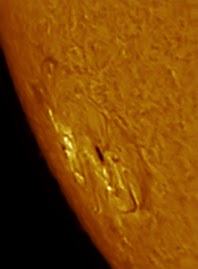
Photo Details
December 23, 2021
Lunt Ha 60mm double-stacked solar telescope
ZWO ASI178MM
SharpCap - 8 Bit Mono
Image Stacking in AutoStakkert
Wavelet Filtering in Registax
Final Adjustments in Photoshop
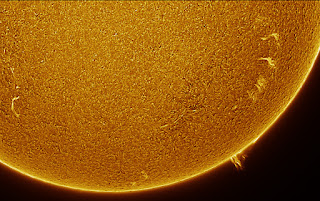
Photo Details
December 23, 2021
Lunt Ha 60mm double-stacked solar telescope
ZWO ASI178MM
SharpCap - 8 Bit Mono
Image Stacking in AutoStakkert
Wavelet Filtering in Registax
Final Adjustments in Photoshop
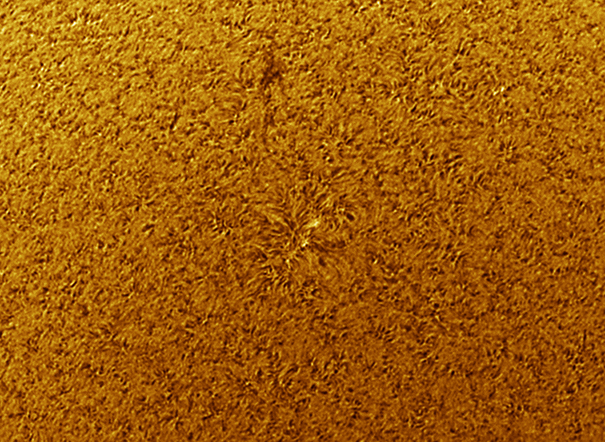
Photo Details
December 22, 2021
Lunt Ha 60mm double-stacked solar telescope
ZWO ASI178MM
SharpCap - 8 Bit Mono
Image Stacking in AutoStakkert
Wavelet Filtering in Registax
Final Adjustments in Photoshop
Photo Details
The Andromeda Galaxy is one of my favorites and never seems to disappoint. Also known as Messier 31, this galaxy is often compared to our own Milky Way since it has a mass of the same order of magnitude (1 trillion solar masses). However, it has an estimated 1 trillion stars which is about double of our home galaxy. The light in the photo began it's journey to Earth about 2.5 million years ago when we were just beginning the ice ages which would last until about 11,700 years ago.
This was my first attempt at imaging through my double-stacked hydrogen-alpha telescope. Tuning both etalons was a challenge, and I still have a lot of room for improvement. However, the level of detail available in the double-stacked mode is really astounding.
Photo Details
2nd attempt at using RGB filters, this time on Saturn. Like my earlier result with Jupiter, it seems to pick up more detail and provides better color. Likely will continue with this method.
This was my first attempt at using RGB filters with a monochrome camera. It's more complicated in post-processing but does seem to pick up more detail and color. I definitely have a lot more to learn, but overall pretty happy with the result.